SEARCH EVENT
Topography of Memory Sixty Years of Operations of the Szczecin Branch of the Social and Cultural Association of Jews in Poland
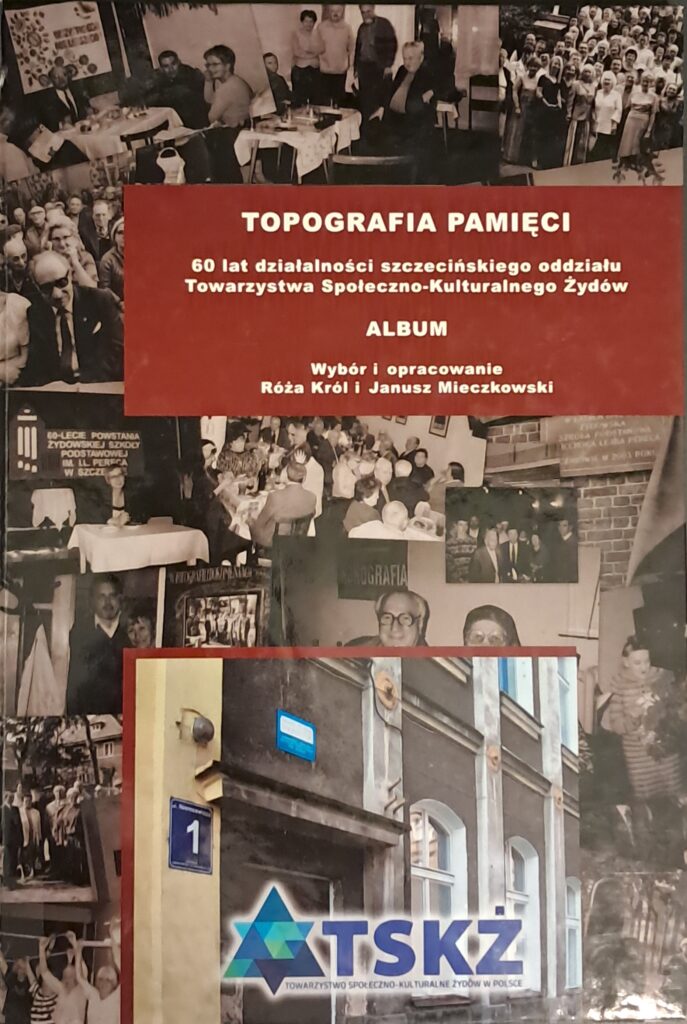
Selected and edited by: Róża Król and Janusz Mieczkowski
For several decades, the Social and Cultural Association of Jews in Poland (TSKŻ) has served as an organisational support platform for anyone wishing to preserve their cultural identity. The role which the TSKŻ has played in the Jewish community was aptly characterised by Cela Gotlib, a former inhabitant of Szczecin, who once wrote in one of her letters that “The TSKŻ used to be a very vibrant organisation. They helped to revive Jewish culture in postwar Poland, and provided support to the destitute and to people in the Recovered Territories who tried to rebuild their lives (…) The TSKŻ’s premises comprised of an office space and a theatre hall which hosted concerts, dance parties, New Year’s Eve balls and literary events. The building itself was also a gathering place for young people who came there to play table tennis or other games. My parents used to be regular visitors there too, as my dad enjoyed playing chess, and many other people liked spending their free time there as well. The TSKŻ has also played a big role in promoting Jewish press and literature.
The Jewish community in Szczecin in the postwar period had to adapt to quite specific conditions. One of such factors was the proximity of the national border, which undoubtedly affected all changes and transformations that took place shortly after the end of World War II. Another factor was its distance from other Jewish communities which had been scattered across Poland.
For over two decades, we have been trying to gather and analyse historical materials on the Jewish community in Szczecin. One of us is active in the Social and Cultural Association of Jews in Poland, and the other is affiliated with the University of Szczecin. We share a common interest in exploring the past. What is also important, is our dedication to the city’s multicultural heritage. Our search for materials on the Jewish community in Szczecin is constantly accompanied by a sense of transience. Memories of the past are becoming increasingly unreliable and selective, and the lack of documentation and records of the TSKŻ’s past activities is becoming ever more apparent. This work has been directly inspired by the desire to offer a retrospective on the occasion of the 60th anniversary of the Social and Cultural Association of Jews in Poland, as well as by a conviction that it is important to preserve the memory of the people, events, meetings, and activities.
From the Preface
LET’S KEEP IN TOUCH.
subscribe our newsletter